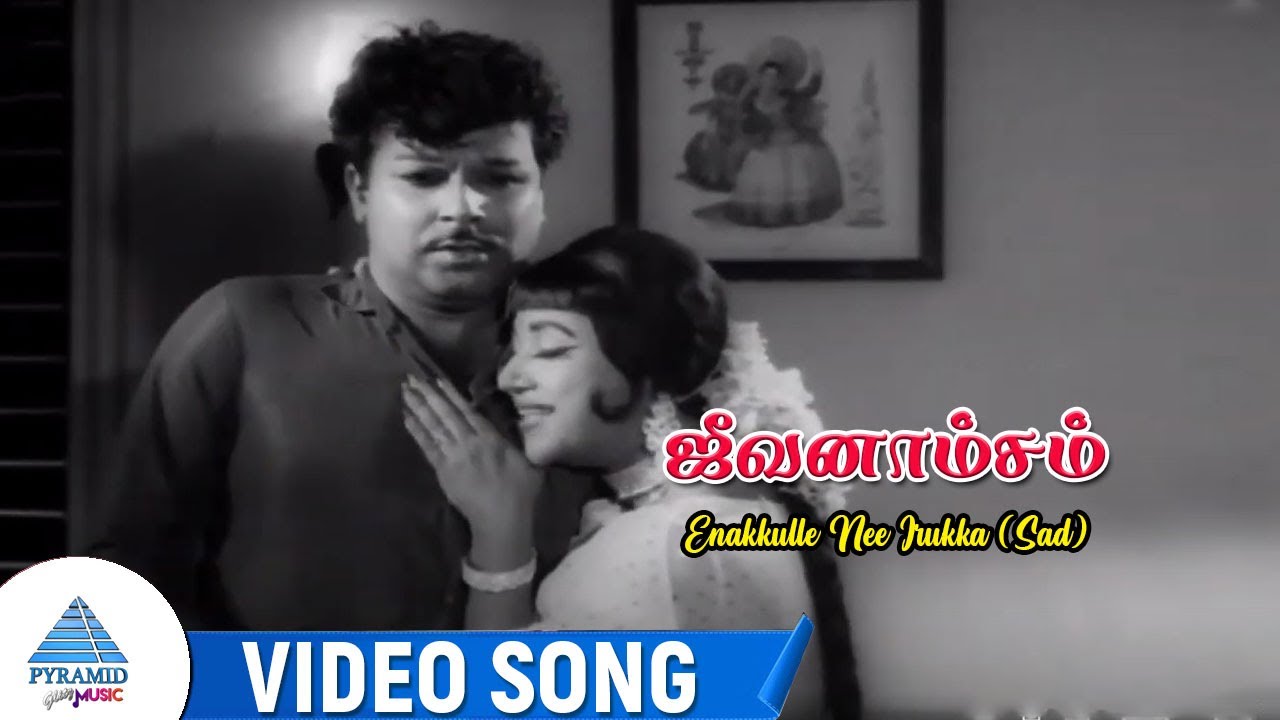
Enakkulle Nee Female Lyrics
From the movie Jeevanamsam - 1968
Enakkulle Nee Female Song Lyrics is the track from Jeevanamsam - 1968 Tamil Film – 1968. This song was sung by பி. சுஷீலா. The music was composed by K. V. Mahadevan. Lyrics works penned by Vaali.
Track Credits & Star Cast
Music & Lyrics
Singers
Star Cast
Not Specified
Enakullae nee irukka Unakullae naan irukka
Ninaikaamal marappadharkku Ninaithaalum mudivathillai
Enakullae nee irukka Unakullae naan irukka
Ninaikaamal marappadharkku Ninaithaalum mudivathillai
Un kannil padukkindra Vovondrum en uruvam
En kannil nilaithirukkum Endrendrum un uruvam
Thanneerai kudithaalum Thaniyaadha thaagam andro
Ennuyiril unnuyirum Inaidhu vittaal theerum andro
Enakullae nee irukka Unakullae naan irukka
Ninaikaamal marappadharkku Ninaithaalum mudivathillai
Thani araiyin kadhavugalai Thaazhpottu adaithaalum
Manamennum thani araiyin Manikadhavu thirandhirukkum
En udalil nee paadhi Un udalil naan paadhi
Inba thunbam iruvarukkum Irudhi varai sari paadhi
Enakullae nee irukka Unakullae naan irukka
Ninaikaamal marappadharkku Ninaithaalum mudivathillai
Song Meaning & Analysis
This song, 'Enakkulle Nee Female', is a poignant expression of deep, inseparable love. The lyrics beautifully articulate a profound connection where the lovers feel completely intertwined, each existing within the other. It speaks to an emotional and spiritual unity so strong that the thought of forgetting the beloved is not just difficult, but utterly impossible, even if one were to consciously attempt it. The imagery of seeing the beloved's form everywhere and the unquenchable thirst for union highlights the intensity of this bond.
The song further emphasizes this unbreakable connection by stating that even physical separation or attempts to isolate oneself cannot deter the mind from dwelling on the beloved. The idea of being 'half of each other's body' and sharing all joys and sorrows equally until the very end underscores a commitment to a lifelong partnership. It's a classic declaration of eternal love, portraying a relationship where two souls have become one, making separation or forgetfulness an inconceivable notion.
Frequently Asked Questions
Who is the singer of Enakkulle Nee Female?
Enakkulle Nee Female is sung by பி. சுஷீலா.
Which movie is Enakkulle Nee Female from?
The song Enakkulle Nee Female is featured in the movie Jeevanamsam - 1968.
Who wrote the lyrics for Enakkulle Nee Female?
The lyrics for Enakkulle Nee Female were written by Vaali with music composed by K. V. Mahadevan.
Is English translation available for Enakkulle Nee Female lyrics?
Yes! Enakkulle Nee Female lyrics from Jeevanamsam - 1968 include line-by-line English translation, English transliteration, and native Tamil script on Lyricsverse.
What is the meaning of Enakkulle Nee Female lyrics?
This song, 'Enakkulle Nee Female', is a poignant expression of deep, inseparable love. The lyrics beautifully articulate a profound connection where the lovers feel completely intertwined, each existing within the other. It speaks to an emotional and spiritual unity so strong that the thought of forgetting the beloved is not just difficult, but utterly impossible, even if one were to consciously attempt it. The imagery of seeing the beloved's form everywhere and the unquenchable thirst for union highlights the intensity of this bond. The song further emphasizes this unbreakable connection by stating that even physical separation or attempts to isolate oneself cannot deter the mind from dwelling on the beloved. The idea of being 'half of each other's body' and sharing all joys and sorrows equally until the very end underscores a commitment to a lifelong partnership. It's a classic declaration of eternal love, portraying a relationship where two souls have become one, making separation or forgetfulness an inconceivable notion.
Song Details
More from Jeevanamsam - 1968
Akkakko Kai Kai
Jeevanamsam - 1968 • K. V. Mahadevan
Jai Sankar, A.V.M. Rajan, C. K. Nagesh, Sivakumar, S. V. Subbaiah, C. R. Vijayakumari, Pushpalatha, Sachchu, Lakshmi, Sowkar Janaki, M. S. Sundaribai, Pandari Bai, Singers : T. M. Soundarajan, P. Susheela

Enakkulle Nee Male
Jeevanamsam - 1968 • K. V. Mahadevan
டி. எம். சௌந்தராஜன்