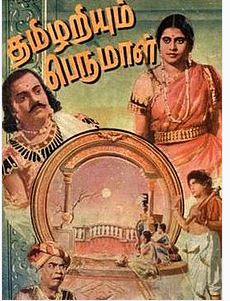
Inbam Tharuvadhu Nee Lyrics
From the movie Tamizhariyum Perumal
Inbam Tharuvadhu Nee Song Lyrics is the track from Tamizhariyum Perumal Tamil Film – 1942. This song was sung by வி. ஏ. செல்லப்பா. The music was composed by B.R.Rejin. Lyrics works penned by Udumalai Narayanakavi.
Track Credits & Star Cast
Music & Lyrics
Singers
Star Cast
Not Specified
Inbam tharuvadhu nee unarvaai Ulagil inbam tharuvadhu nee unarvaai
Idaiyooraagum thiraiyagandraal Ulagil inbam tharuvadhu nee unarvaai
Idaiyooraagum thiraiyagandraal Ulagil inbam tharuvadhu nee unarvaai
Kandham suvaiyisai…ee…ae…vaa…aa…vaa… Kandham suvaiyisai kaatchi uttrarivum
Kandham suvaiyisai kaatchi uttrarivum Aimbhulanum paramaanandham pera
Aimbhulanum paramaanandham pera Inbam tharuvadhu nee unarvaai
Kaadhal iruvarin karutthondraagum Kaadhal iruvarin karutthondraagum
Podhinil adhu pol ilaiyor sugamae Kaadhal iruvarin karutthondraagum
Podhinil adhu pol ilaiyor sugamae Odhum kadavul padhiyaagavum naam…
Aa…aa…aa… Odhum kadavul padhiyaagavum naam
Odhum kadavul padhiyaagavum naam Ondodi polum snaegam kondaal
Ondodi polum snaegam kondaal Ondodi polum snaegam kondaal
Inbam perum vazhi yaam unarvom Idaiyooraagum thiraiyagandraal
Ulagil inbam perum vazhi yaam unarvom
Song Meaning & Analysis
The song "Inbam Tharuvadhu Nee" from the 1942 film 'Tamizhariyum Perumal' is a profound philosophical and devotional piece that delves into the nature of joy and self-realization. The lyrics, penned by Udumalai Narayanakavi, emphasize that true happiness originates from within oneself, rather than from external sources. It posits that by removing the "curtain of obstacles" – symbolic of ignorance, ego, or worldly attachments – one can attain an understanding that the source of all joy resides within. This inner realization is presented as the key to experiencing supreme bliss through the five senses and in all aspects of life.
The song further explores the concept of unity, both in human love and divine devotion. It draws a parallel between the profound pleasure experienced when two lovers' minds unite and the ultimate bliss achieved by fostering an unwavering, devoted bond with God, likening it to a wife's devotion to her husband. This spiritual union is portrayed as the highest form of joy, suggesting that by aligning one's inner self with the divine and removing internal barriers, one can truly comprehend and experience the path to lasting happiness in this world.
Frequently Asked Questions
Who is the singer of Inbam Tharuvadhu Nee?
Inbam Tharuvadhu Nee is sung by வி. ஏ. செல்லப்பா.
Which movie is Inbam Tharuvadhu Nee from?
The song Inbam Tharuvadhu Nee is featured in the movie Tamizhariyum Perumal.
Who wrote the lyrics for Inbam Tharuvadhu Nee?
The lyrics for Inbam Tharuvadhu Nee were written by Udumalai Narayanakavi with music composed by B.R.Rejin.
Is English translation available for Inbam Tharuvadhu Nee lyrics?
Yes! Inbam Tharuvadhu Nee lyrics from Tamizhariyum Perumal include line-by-line English translation, English transliteration, and native Tamil script on Lyricsverse.
What is the meaning of Inbam Tharuvadhu Nee lyrics?
The song "Inbam Tharuvadhu Nee" from the 1942 film 'Tamizhariyum Perumal' is a profound philosophical and devotional piece that delves into the nature of joy and self-realization. The lyrics, penned by Udumalai Narayanakavi, emphasize that true happiness originates from within oneself, rather than from external sources. It posits that by removing the "curtain of obstacles" – symbolic of ignorance, ego, or worldly attachments – one can attain an understanding that the source of all joy resides within. This inner realization is presented as the key to experiencing supreme bliss through the five senses and in all aspects of life. The song further explores the concept of unity, both in human love and divine devotion. It draws a parallel between the profound pleasure experienced when two lovers' minds unite and the ultimate bliss achieved by fostering an unwavering, devoted bond with God, likening it to a wife's devotion to her husband. This spiritual union is portrayed as the highest form of joy, suggesting that by aligning one's inner self with the divine and removing internal barriers, one can truly comprehend and experience the path to lasting happiness in this world.