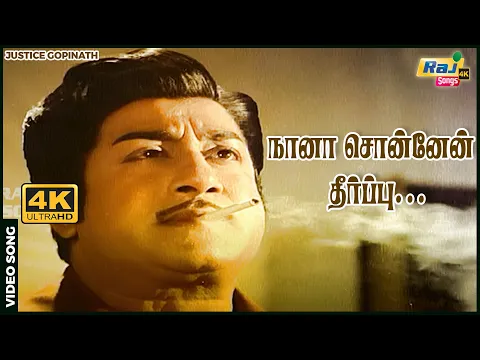
Naanaa Sonnen Lyrics
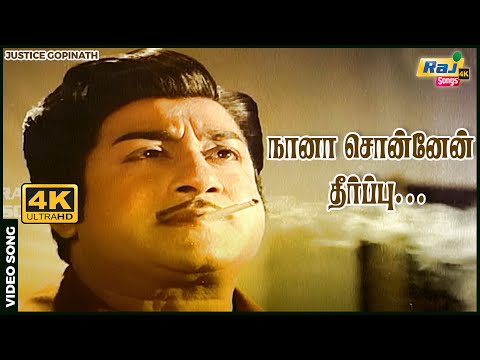
From the movie Justice Gopinath Tamil
Naanaa Sonnen Song Lyrics is the track from Justice Gopinath Tamil Tamil Film – 1978. This song was sung by டி. எம். சௌந்தராஜன்.
Track Credits & Star Cast
Music & Lyrics
Singers
Star Cast
Not Specified
Singer : T. M. Soundarajan
Music Director : M. S. Vishwanathan
Lyricist : Vaali
Naana sonnen theerppu Satta nool thaan endhn kaappu
Naana sonnen theerppu Satta nool thaan endhn kaappu
Naan sonnadhai sollum kilippillai Ada iraivaa en mael thavarillai
Naan sonnadhai sollum kilippillai Ada iraivaa en mael thavarillai
Dialogue
Naana sonnen theerppu Satta nool thaan endhn kaappu
Chozhan maganai thaeril kondrathu Manuvin saatchiyappa
Chozhan maganai thaeril kondrathu Manuvin saatchiyappa
Sibiyin sadhaiyai paravaikkendrathu Manadhin saatchiyappa
Sibiyin sadhaiyai paravaikkendrathu Manadhin saatchiyappa
Pithalai endrae thangathai solvadhu Manidhan saatchiyappaa
Iththarai meedhu sathiyamaanadhu Deivathin saatchiyappaa
Naana sonnen theerppu Satta nool thaan endhn kaappu
Vaadham kaettu vazhakkai theerkkum Adhu thaan enadhu madhi
Enakkum melae iruppavan oruvan Avan thaan needhibadhi
Vaadham kaettu vazhakkai theerkkum Adhu thaan enadhu madhi
Enakkum melae iruppavan oruvan Avan thaan needhibadhi
Sariyoo thavaroo baaram ellaam Avan mel pottuvitten
Yeidhavan irukka ambai novudhu Muraiyaa kettuvitten
Naana sonnen theerppu Satta nool thaan endhn kaappu
Naan sonnadhai sollum kilippillai Ada iraivaa en mael thavarillai
Sonnadhai sollum kilippillai Ada iraivaa en mael thavarillai
Naana sonnen theerppu Satta nool thaan endhn kaappu
Song Meaning & Analysis
This song, "Naanaa Sonnen," from the 1978 film 'Justice Gopinath,' is a profound monologue delivered from the perspective of a judge. The lyrics articulate the judge's role as an impartial interpreter of the law, emphasizing that his verdicts are not personal opinions but rather reflections of established legal texts. He likens himself to a parrot, merely repeating what the law dictates, thereby absolving himself of personal blame and appealing to a higher divine authority. The song delves into the philosophical aspects of justice, contrasting human law (Manu's testimony) with moral conscience (Sibi's sacrifice) and the fallibility of human perception against divine truth.
The judge further elaborates on his limited role, stating that his intellect is solely for hearing arguments and applying the law. He humbly acknowledges a supreme being as the ultimate Judge, upon whom he places the entire burden of right and wrong. The poignant question, "Is it fair to blame the arrow when the one who shot it is present?" powerfully conveys his stance: he is merely an instrument of justice, not its originator. The song thus explores themes of duty, impartiality, divine justice, and the inherent limitations of human judgment within the legal framework.
Frequently Asked Questions
Who is the singer of Naanaa Sonnen?
Naanaa Sonnen is sung by டி. எம். சௌந்தராஜன்.
Which movie is Naanaa Sonnen from?
The song Naanaa Sonnen is featured in the movie Justice Gopinath Tamil.
Who wrote the lyrics for Naanaa Sonnen?
The lyrics for Naanaa Sonnen were written by Unknown with music composed by Unknown.
Is English translation available for Naanaa Sonnen lyrics?
Yes! Naanaa Sonnen lyrics from Justice Gopinath Tamil include line-by-line English translation, English transliteration, and native Tamil script on Lyricsverse.
What is the meaning of Naanaa Sonnen lyrics?
This song, "Naanaa Sonnen," from the 1978 film 'Justice Gopinath,' is a profound monologue delivered from the perspective of a judge. The lyrics articulate the judge's role as an impartial interpreter of the law, emphasizing that his verdicts are not personal opinions but rather reflections of established legal texts. He likens himself to a parrot, merely repeating what the law dictates, thereby absolving himself of personal blame and appealing to a higher divine authority. The song delves into the philosophical aspects of justice, contrasting human law (Manu's testimony) with moral conscience (Sibi's sacrifice) and the fallibility of human perception against divine truth. The judge further elaborates on his limited role, stating that his intellect is solely for hearing arguments and applying the law. He humbly acknowledges a supreme being as the ultimate Judge, upon whom he places the entire burden of right and wrong. The poignant question, "Is it fair to blame the arrow when the one who shot it is present?" powerfully conveys his stance: he is merely an instrument of justice, not its originator. The song thus explores themes of duty, impartiality, divine justice, and the inherent limitations of human judgment within the legal framework.
Music Video