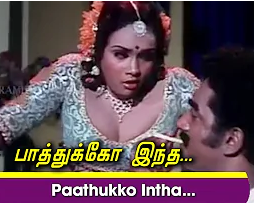
Paathukko Indha Panjavarna Lyrics
From the movie Sirai
Paathukko Indha Panjavarna Song Lyrics is the track from Sirai Tamil Film – 1984, Starring Lakshmi, Rajesh, Pandiyan, Ilavarasi, S. S. Chandran, V. Gopalakrishnan, Isari Velan, Anuradha. This song was sung by எஸ். ஜானகி. The music was composed by M. S. Viswanathan. Lyrics works penned by Muthulingam.
Track Credits & Star Cast
Music & Lyrics
Singers



Paaththukkointha panjavarna poongiliyai
Pattu vanna poongidiyai saeththukko
Paaththukkointha panjavarna poongiliyai
Pattu vanna poongidiyai saeththukko
Mottu vitta mullaikodi thulluthu
Muththamittu ottikkolla solluthu
Intha katti vacha puththakaththai Kotti vachcha raththinaththai kattiko
Ennai thottukko
Paaththukkointha panjavarna poongiliyai
Pattu vanna poongidiyai saeththukko
Ooralum uththamargal niththam varum santha madam
Kaadhoram antharanga sangathigal sollumidam
Ooralum uththamargal niththam varum santha madam
Kaadhoram antharanga sangathigal sollumidam
Jaadhi ingu illai shanthi engal ellai
Aadugindra thennai alli thinnu ennai
Jaadhi ingu illai shanthi engal ellai
Aadugindra thennai alli thinnu ennai
Paaththukkointha panjavarna poongiliyai Pattu vanna poongidiyai saeththukko
Mottu vitta mullaikodi thulluthu Muththamittu ottikkolla solluthu
Naalthorum kannagiyin karputhanai sonnathenna
Yae oorthorum kanniyarai thedi kondu vanthathenna
Naalthorum kannagiyin karputhanai sonnathenna
Yae oorthorum kanniyarai thedi kondu vanthathenna
Kolgaiyattra neegal kulla nari koottam
Ungalidam naangal maatti konda thottam
Kolgaiyattra neegal kulla nari koottam
Ungalidam naangal maatti konda thottam
Paaththukkointha panjavarna poongiliyai Pattu vanna poongidiyai saeththukko
Mottu vitta mullaikodi thulluthu Muththamittu ottikkolla solluthu
Intha katti vacha puththakaththai Kotti vachcha raththinaththai kattiko
Ennai thottukko
Song Meaning & Analysis
This song, 'Paathukko Indha Panjavarna,' from the movie 'Sirai' (1984), is a poignant and complex piece sung from the perspective of a woman, likely a courtesan or someone in a similar profession. Initially, it presents an alluring invitation, using metaphors like a "five-colored parrot-like beauty," a "silken-hued creeper," a "bound book," and a "poured-out gem" to describe herself, expressing desire and readiness for intimacy. The setting is described as a place where "noble rulers" frequent and secrets are shared, emphasizing a world free from conventional societal norms like caste, where peace is the only boundary, and she offers herself openly.
However, the song takes a sharp turn, revealing a deeper, more critical layer. The lyrics shift to question societal hypocrisy, contrasting the veneration of figures like Kannagi for her chastity with the widespread practice of men seeking out virgins from every town. The woman then directly confronts her patrons, labeling them as "jackals without principles" and lamenting that she and others like her are a "garden caught by you." This powerful shift transforms the song from a simple seductive number into a bold social commentary, exposing the exploitation and double standards faced by women in her position, blending initial allure with a bitter, defiant accusation.
Frequently Asked Questions
Who is the singer of Paathukko Indha Panjavarna?
Paathukko Indha Panjavarna is sung by எஸ். ஜானகி.
Which movie is Paathukko Indha Panjavarna from?
The song Paathukko Indha Panjavarna is featured in the movie Sirai.
Who wrote the lyrics for Paathukko Indha Panjavarna?
The lyrics for Paathukko Indha Panjavarna were written by Muthulingam with music composed by M. S. Viswanathan.
Is English translation available for Paathukko Indha Panjavarna lyrics?
Yes! Paathukko Indha Panjavarna lyrics from Sirai include line-by-line English translation, English transliteration, and native Tamil script on Lyricsverse.
What is the meaning of Paathukko Indha Panjavarna lyrics?
This song, 'Paathukko Indha Panjavarna,' from the movie 'Sirai' (1984), is a poignant and complex piece sung from the perspective of a woman, likely a courtesan or someone in a similar profession. Initially, it presents an alluring invitation, using metaphors like a "five-colored parrot-like beauty," a "silken-hued creeper," a "bound book," and a "poured-out gem" to describe herself, expressing desire and readiness for intimacy. The setting is described as a place where "noble rulers" frequent and secrets are shared, emphasizing a world free from conventional societal norms like caste, where peace is the only boundary, and she offers herself openly. However, the song takes a sharp turn, revealing a deeper, more critical layer. The lyrics shift to question societal hypocrisy, contrasting the veneration of figures like Kannagi for her chastity with the widespread practice of men seeking out virgins from every town. The woman then directly confronts her patrons, labeling them as "jackals without principles" and lamenting that she and others like her are a "garden caught by you." This powerful shift transforms the song from a simple seductive number into a bold social commentary, exposing the exploitation and double standards faced by women in her position, blending initial allure with a bitter, defiant accusation.