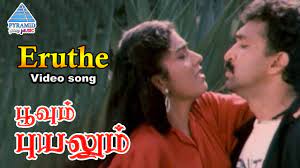
Yeruthae Mooligai Poguthae Lyrics
From the movie Poovum Puyalum
Yeruthae Mooligai Poguthae Song Lyrics is the track from Poovum Puyalum Tamil Film – 1988. This song was sung by கே. எஸ். சித்ரா. The music was composed by S. A. Rajkumar.
Track Credits & Star Cast
Yerudhae mooligai poguthae naaligai
Yerudhae mooligai poguthae naaligai
Bodhai thaan vaaliba dhesathin vaadagai
Yerudhae mooligai poguthae naaligaiyerudhae mooligai
Nadhiyilae nadakkiren malaigalai anaikkiren
Udalindri parakkiren nilavinai pidikkiren
Kaatrodu pesi pesi naan gnyaani aagiren
Naetrillai naalai illai indrennai aalgiren
Yogam thrarum sugam en anubhavamae
Yerudhae mooligai poguthae naaligai Yerudhae mooligai
Paavama punniyama yaavumae poiyadaa Aandiyoo arasanoo povadhum mannadaa
Saagatha varam tharum saami Sariyaana sarakkondruthaan
Boolooga sorgathai kaana sanjeevi mooligai thaan Aanandhamae ellai nam ulaginilae
Yerudhae mooligai poguthae naaligai
Yerudhae mooligai poguthae naaligai
Bodhai thaan vaaliba dhesathin vaadagai
Yerudhae mooligai poguthae naaligaiyerudhae mooligai
Song Meaning & Analysis
This song from 'Poovum Puyalum' delves into a state of altered consciousness, likely induced by a "mooligai" (herb), which leads to profound feelings of liberation and euphoria. The lyrics describe a psychedelic journey where the protagonist transcends physical limitations, experiencing out-of-body sensations like flying and embracing mountains. This altered state is portrayed as a path to wisdom, where the boundaries of time (past, present, future) dissolve, and the individual lives purely in the moment, comparing this intense bliss to the serenity achieved through yoga.
Beyond the immediate sensory experience, the song also touches upon deeper philosophical themes. It questions conventional morality, suggesting that concepts of sin and virtue become irrelevant in this elevated state. The lyrics reflect on the transient nature of worldly distinctions, asserting that all, whether beggar or king, ultimately return to dust. The "mooligai" is elevated to a divine status, described as a "perfect substance" that grants an experience akin to immortality and allows one to witness "earthly heaven," culminating in the idea that pure bliss is the ultimate state achievable in this world.
Frequently Asked Questions
Who is the singer of Yeruthae Mooligai Poguthae?
Yeruthae Mooligai Poguthae is sung by கே. எஸ். சித்ரா.
Which movie is Yeruthae Mooligai Poguthae from?
The song Yeruthae Mooligai Poguthae is featured in the movie Poovum Puyalum.
Who wrote the lyrics for Yeruthae Mooligai Poguthae?
The lyrics for Yeruthae Mooligai Poguthae were written by Unknown with music composed by S. A. Rajkumar.
Is English translation available for Yeruthae Mooligai Poguthae lyrics?
Yes! Yeruthae Mooligai Poguthae lyrics from Poovum Puyalum include line-by-line English translation, English transliteration, and native Tamil script on Lyricsverse.
What is the meaning of Yeruthae Mooligai Poguthae lyrics?
This song from 'Poovum Puyalum' delves into a state of altered consciousness, likely induced by a "mooligai" (herb), which leads to profound feelings of liberation and euphoria. The lyrics describe a psychedelic journey where the protagonist transcends physical limitations, experiencing out-of-body sensations like flying and embracing mountains. This altered state is portrayed as a path to wisdom, where the boundaries of time (past, present, future) dissolve, and the individual lives purely in the moment, comparing this intense bliss to the serenity achieved through yoga. Beyond the immediate sensory experience, the song also touches upon deeper philosophical themes. It questions conventional morality, suggesting that concepts of sin and virtue become irrelevant in this elevated state. The lyrics reflect on the transient nature of worldly distinctions, asserting that all, whether beggar or king, ultimately return to dust. The "mooligai" is elevated to a divine status, described as a "perfect substance" that grants an experience akin to immortality and allows one to witness "earthly heaven," culminating in the idea that pure bliss is the ultimate state achievable in this world.