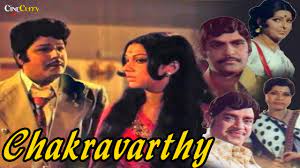
Gangai Yamunai Saraswathi Lyrics
From the movie Chakkravarthy - 1977
Gangai Yamunai Saraswathi Song Lyrics is the track from Chakkravarthy - 1977 Tamil Film – 1977. This song was sung by டி. எம். சௌந்தராஜன். The music was composed by V. Kumar. Lyrics works penned by Kannadasan.
Track Credits & Star Cast
Music & Lyrics
Singers
Star Cast
Not Specified
Gangai yamunai saraswathi Endru nadhigal moondrallava
Paadhai moondrum veraanaalum Thanneer ondrallavaa
Gangai yamunai saraswathi Endru nadhigal moondrallava
Paadhai moondrum veraanaalum Thanneer ondrallavaa
Raman engae kugan thaan engae Angadhan pirandhadhu thaan engae
Nanbargal aanaar manamum gunamum Sangamam aanadhu angae
Nellil irundhu umiyai pirithaal Meendum servadhu engae
Nerungaadhu nerungivittaal Piriya vidathu anbu
Gangai yamunai saraswathi Endru nadhigal moondrallava
Paadhai moondrum veraanaalum Thanneer ondrallavaa
Sattam enbathu iruttarai endru Arinjar sonnar andru
Dharumam ennum vilakkai kondu Thedi paarungal endru
Ovvoru manidhan ullathilum Mirugamum deivamum undu
Mirugangalai viratti vittu Deivangal aavom indru
Gangai yamunai saraswathi Endru nadhigal moondrallava
Paadhai moondrum veraanaalum Thanneer ondrallavaa
Udal noi maruthuvam undu Manadhil noikku enna marundhu
Ovvoru manadhaiyum aatti veikkindraar Uyarathil oruvan irundhu
Needhi nyaayam enbavai ellam Thalaivan aalum aatchi
Neengal illai naanum illai Avanae courtukkum saatchi
Gangai yamunai saraswathi Endru nadhigal moondrallava
Paadhai moondrum veraanaalum Thanneer ondrallavaa
Song Meaning & Analysis
The song "Gangai Yamunai Saraswathi" from the 1977 film 'Chakkravarthy' is a profound philosophical piece penned by the legendary Kannadasan. It uses the metaphor of the three sacred rivers – Ganga, Yamuna, and Saraswati – whose paths diverge but whose waters ultimately unite, to convey the idea of underlying unity despite apparent differences. The lyrics explore themes of friendship, the enduring nature of love, and the duality of human nature, suggesting that while individuals may seem distinct, their core essence or shared humanity binds them.
Further, the song delves into societal and spiritual reflections. It questions the efficacy of man-made laws, advocating for righteousness as a guiding light, and highlights the constant struggle between the 'beast' and the 'divine' within each person, urging listeners to embrace their higher selves. Ultimately, it points towards a higher power or divine justice that oversees all, implying that true justice and the ultimate truth transcend human institutions and are governed by a supreme entity. The song serves as a profound commentary on life, morality, and spirituality.
Frequently Asked Questions
Who is the singer of Gangai Yamunai Saraswathi?
Gangai Yamunai Saraswathi is sung by டி. எம். சௌந்தராஜன்.
Which movie is Gangai Yamunai Saraswathi from?
The song Gangai Yamunai Saraswathi is featured in the movie Chakkravarthy - 1977.
Who wrote the lyrics for Gangai Yamunai Saraswathi?
The lyrics for Gangai Yamunai Saraswathi were written by Kannadasan with music composed by V. Kumar.
Is English translation available for Gangai Yamunai Saraswathi lyrics?
Yes! Gangai Yamunai Saraswathi lyrics from Chakkravarthy - 1977 include line-by-line English translation, English transliteration, and native Tamil script on Lyricsverse.
What is the meaning of Gangai Yamunai Saraswathi lyrics?
The song "Gangai Yamunai Saraswathi" from the 1977 film 'Chakkravarthy' is a profound philosophical piece penned by the legendary Kannadasan. It uses the metaphor of the three sacred rivers – Ganga, Yamuna, and Saraswati – whose paths diverge but whose waters ultimately unite, to convey the idea of underlying unity despite apparent differences. The lyrics explore themes of friendship, the enduring nature of love, and the duality of human nature, suggesting that while individuals may seem distinct, their core essence or shared humanity binds them. Further, the song delves into societal and spiritual reflections. It questions the efficacy of man-made laws, advocating for righteousness as a guiding light, and highlights the constant struggle between the 'beast' and the 'divine' within each person, urging listeners to embrace their higher selves. Ultimately, it points towards a higher power or divine justice that oversees all, implying that true justice and the ultimate truth transcend human institutions and are governed by a supreme entity. The song serves as a profound commentary on life, morality, and spirituality.