Nee Paadum Paadal Lyrics
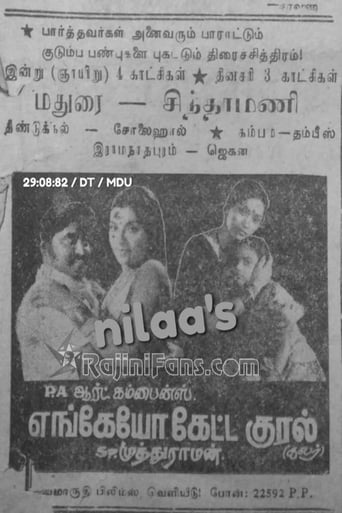
From the movie Enkeyo Ketta Kural
Nee Paadum Paadal Song Lyrics is the track from Enkeyo Ketta Kural Tamil Film – 1982, Starring Radha, Rajinikanth, Ambika, Meena, Delhi Ganesh, Kamala Kamesh, V. S. Raghavan. This song was sung by எஸ். ஜானகி. The music was composed by Ilayaraja. Lyrics works penned by Panchu Arunachalam.
Track Credits & Star Cast
Music & Lyrics
Singers
Star Cast


Nee paadum paadal yedhu Nee paadum paadal yedhu
Thaalathil seraadha paadal undaa Raagathil illaadha geetham undaa
Baavangal illaadha vaazhvil
Nee paadum paadal yedhu Nee paadum paadal yedhu
Panpaadu saeraadha Ennangal paazhaagum
Anbodu seraadha Aasaigal veenaagum
Dharmathil adangaadha ullam endrum Thallaadi thallaadi thunbam kollum
Oru kaaval yaedhu kanavanai pirindhaal Kovil yaedhu iraivanai marandhaal
Nee paadum paadal yedhu Nee paadum paadal yedhu
Kaalangal nooraaga Kaangindra panbaadu
Vaedhangal naalodu Vilaigindra nal vaazhvu
Vaelikkul naam kanda poonthottamae Thaalikku naam thandha thaathpariyamae
Ini kaasiyodu gangaiyum illai Aasi koorum karunaiyum illai
Nee paadum paadal yedhu Nee paadum paadal yedhu
Thaalathil seraadha paadal undaa Raagathil illaadha geetham undaa
Baavangal illaadha vaazhvil
Song Meaning & Analysis
This poignant song from 'Enkeyo Ketta Kural' delves into the philosophical underpinnings of life, love, and traditional values, likely voiced by the protagonist, a woman deeply rooted in her cultural ethos. It questions the essence of existence without fundamental principles, comparing life's harmony to music – a song without rhythm or raga, a life without emotional expression. The lyrics emphasize the importance of virtue (panbu), love (anbu), and righteousness (dharmam), suggesting that any deviation leads to ruin and sorrow. The song powerfully equates the sanctity of marriage and the husband's role to divine protection and spiritual solace, highlighting the profound significance of these bonds in her world.
The latter part of the song elevates the husband to the status of a cherished tradition, a sacred garden within her protected life, and the ultimate meaning of her 'thaali' (mangalsutra). It expresses a deep sense of loss or despair, implying that without this central pillar, all other spiritual and cultural anchors – like the holy city of Kasi, the sacred river Ganga, or divine compassion – lose their significance. The song beautifully encapsulates the emotional depth and traditional worldview of a woman for whom her marital bond is the very core of her identity and spiritual fulfillment, making it a heartfelt plea or a lament about the potential erosion of these cherished values.
Frequently Asked Questions
Who is the singer of Nee Paadum Paadal?
Nee Paadum Paadal is sung by எஸ். ஜானகி.
Which movie is Nee Paadum Paadal from?
The song Nee Paadum Paadal is featured in the movie Enkeyo Ketta Kural.
Who wrote the lyrics for Nee Paadum Paadal?
The lyrics for Nee Paadum Paadal were written by Panchu Arunachalam with music composed by Ilayaraja.
Is English translation available for Nee Paadum Paadal lyrics?
Yes! Nee Paadum Paadal lyrics from Enkeyo Ketta Kural include line-by-line English translation, English transliteration, and native Tamil script on Lyricsverse.
What is the meaning of Nee Paadum Paadal lyrics?
This poignant song from 'Enkeyo Ketta Kural' delves into the philosophical underpinnings of life, love, and traditional values, likely voiced by the protagonist, a woman deeply rooted in her cultural ethos. It questions the essence of existence without fundamental principles, comparing life's harmony to music – a song without rhythm or raga, a life without emotional expression. The lyrics emphasize the importance of virtue (panbu), love (anbu), and righteousness (dharmam), suggesting that any deviation leads to ruin and sorrow. The song powerfully equates the sanctity of marriage and the husband's role to divine protection and spiritual solace, highlighting the profound significance of these bonds in her world. The latter part of the song elevates the husband to the status of a cherished tradition, a sacred garden within her protected life, and the ultimate meaning of her 'thaali' (mangalsutra). It expresses a deep sense of loss or despair, implying that without this central pillar, all other spiritual and cultural anchors – like the holy city of Kasi, the sacred river Ganga, or divine compassion – lose their significance. The song beautifully encapsulates the emotional depth and traditional worldview of a woman for whom her marital bond is the very core of her identity and spiritual fulfillment, making it a heartfelt plea or a lament about the potential erosion of these cherished values.