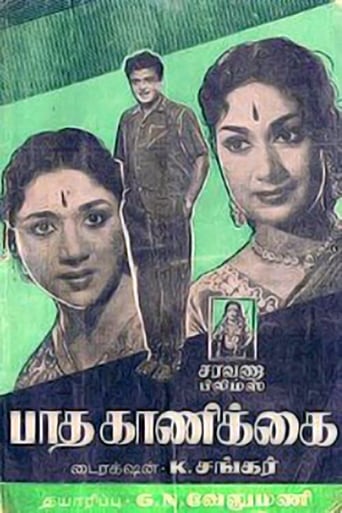
Veedu Varai Uravu Lyrics
From the movie Paadha Kaanikkai
Veedu Varai Uravu Song Lyrics is the track from Paadha Kaanikkai Tamil Film – 1962, Starring Gemini Ganesan, Savitri, C. R. Vijayakumari, M. R. Radha, J. P. Chandrababu, Kamal Haasan, S. V. Subbaiah, S. A. Asokan, M. V. Rajamma, C. K. Saraswathi. This song was sung by டி.எம். சௌந்தரராஜன். The music was composed by Viswanathan Ramamoorthy. Lyrics works penned by Lyricist Not Known.
Track Credits & Star Cast
Music & Lyrics
Singers
Star Cast


Aadiya aatam Enna pesiya vaarthai
Enna thediya selvam Enna
Thirandathor Sutramenna kooduvitu
Aavi ponaal koodavae varuvadhenna
{ Veedu varai uravu Veedhi varai manaivi
Kaadu varai pillai Kadaisi varai yaro } (2)
{ Aadum varai aatam Aayirathil naatam } (2)
Koodivarum kootam Kollivarai varuma
Veedu varai uravu Veedhi varai manaivi
Kaadu varai pillai { Kadaisi varai yaro } (2)
{ Thottiluku annai Kattiluku kanni } (2)
Pattiniku theeni Ketta pinbu gnyaani
Veedu varai uravu Veedhi varai manaivi
Kaadu varai pillai { Kadaisi varai yaro } (2)
{ Sendravanai ketaal Vandhuvidu enban
Vandhavanai ketaal Sendruvidu enban } (2)
Sendruvidu enban
Veedu varai uravu Veedhi varai manaivi
Kaadu varai pillai { Kadaisi varai yaro } (2)
Vituvidum aavi Pattuvidum meni
Suttuvidum nerupu { Sooniyathil nilaipu } (2)
Veedu varai uravu Veedhi varai manaivi
Kaadu varai pillai { Kadaisi varai yaro } (2)
Song Meaning & Analysis
This song is a profound philosophical reflection on the transient nature of human relationships and material possessions. It questions the ultimate value of life's pursuits – actions, words, wealth, and family – in the face of death. The central theme revolves around the idea that worldly connections are temporary: relatives accompany you to your home, your spouse to the street, and your children to the cremation ground. The poignant question, "Who comes till the very end?", underscores the solitude of the soul's final journey and the ultimate realization that only one's own deeds or spiritual essence might remain.
The lyrics further explore the cyclical nature of life and death, the pursuit of desires, and the eventual wisdom gained through hardship. It highlights the fleeting roles people play in one's life – a mother for the cradle, a lover for the bed, food for hunger, and wisdom emerging from ruin. The song concludes with the stark reality of death: the soul departs, the body perishes, fire consumes it, and all that remains is an existence in nothingness. It serves as a powerful reminder of mortality and encourages introspection on what truly matters beyond the ephemeral attachments of the world.
Frequently Asked Questions
Who is the singer of Veedu Varai Uravu?
Veedu Varai Uravu is sung by டி.எம். சௌந்தரராஜன்.
Which movie is Veedu Varai Uravu from?
The song Veedu Varai Uravu is featured in the movie Paadha Kaanikkai.
Who wrote the lyrics for Veedu Varai Uravu?
The lyrics for Veedu Varai Uravu were written by Lyricist Not Known with music composed by Viswanathan Ramamoorthy.
Is English translation available for Veedu Varai Uravu lyrics?
Yes! Veedu Varai Uravu lyrics from Paadha Kaanikkai include line-by-line English translation, English transliteration, and native Tamil script on Lyricsverse.
What is the meaning of Veedu Varai Uravu lyrics?
This song is a profound philosophical reflection on the transient nature of human relationships and material possessions. It questions the ultimate value of life's pursuits – actions, words, wealth, and family – in the face of death. The central theme revolves around the idea that worldly connections are temporary: relatives accompany you to your home, your spouse to the street, and your children to the cremation ground. The poignant question, "Who comes till the very end?", underscores the solitude of the soul's final journey and the ultimate realization that only one's own deeds or spiritual essence might remain. The lyrics further explore the cyclical nature of life and death, the pursuit of desires, and the eventual wisdom gained through hardship. It highlights the fleeting roles people play in one's life – a mother for the cradle, a lover for the bed, food for hunger, and wisdom emerging from ruin. The song concludes with the stark reality of death: the soul departs, the body perishes, fire consumes it, and all that remains is an existence in nothingness. It serves as a powerful reminder of mortality and encourages introspection on what truly matters beyond the ephemeral attachments of the world.